Electrochemistry Takes The Heat
Buy Uncle Steve's: Hot Pepper Seeds Dried Chiles Chile Powders
Eating chilli sauces and the burning sensation on your tongue are permanently interlinked; you can"t have one without the other. But there is a fine line between nicely spicy, and unpleasantly painful. UK electrochemists are now offering help to the food industry and chilli lovers in the form of a more accurate technique using carbon nanotubes for measuring the strength of hot sauces.
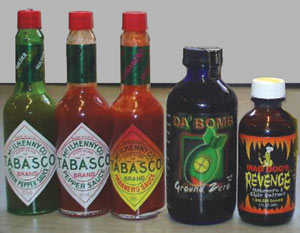
The electrochemistry method was used to measure the concentrations of capsaicinoids in a range of commercially available sauces
Richard Compton and his team at Oxford University used the electroanalytical technique adsorptive stripping voltammetry (AdsVS), with multi-walled carbon nanotube based electrodes, to measure the heat in five commercially available sauces. The group used their method to measure the concentrations of capsaicinoids - the compounds that make chillies hot - in sauces ranging from the mild Tabasco Green Pepper sauce to the stupendously hot Mad Dog's Revenge. The traditional Scoville method for quantifying the heat of foods is considered rather subjective, but remains the dominant one used by industry. It involves repeatedly diluting a food sample to the point at which a panel of five expert tasters cannot detect any heat. Samples are given a Scoville rating equal to the number of dilutions required.
"AdsVS is a fantastic detection technique for capsaicinoids because it's so simple - it integrates over all of the heat creating constituents because all the capsaicinoids have essentially the same electrochemical response" - Richard Compton Compton says, "AdsVS is a fantastic detection technique for capsaicinoids because it's so simple - it integrates over all of the heat creating constituents because all the capsaicinoids have essentially the same electrochemical response." The "multi-walled carbon nanotubes provide a huge surface-area for adsorption of capsaicin and it's [structurally] perfect - akin to the basal plane of graphite", he explains. This adsorption prior to detection leads to an enhanced electrochemical response. The capsaicinoid concentrations obtained by AdsVS can also be converted into Scoville units. "You could also use HPLC but that would involve separation of all the capsaicinoid components," says Compton. HPLC is also unfavourable because it is expensive and requires bulky equipment.
The AdsVS method has a high potential for use as a quality control tool in the food industry.
According to Compton, AdsVS "is suitable for use with handheld electronics, providing an
instantaneous measurement of the Scoville unit". He adds, "We have put in a patent on the
technology, and ISIS [Oxford University's technology transfer subsidiary] is actively seeking
backers to commercialise it."
Kenneth Ozoemena, an expert in electrochemical nanotechnology from the University of Pretoria,
South Africa, is highly complimentary about the research, saying "I strongly feel that this work
will go down in history as one of the excellent advantages of electroanalytical techniques over
other known probes for applied analytical chemistry".
May 2008 James Hodge
Still need more HOT Chile Pepper information?
Check out the "Pepper History" page.
Check out the "Chile Heat
Scale" page.
What is the
World's Hottest Chile Pepper?
Hot Chile Pepper Medical Uses
Uncle Steve's HOT Stuff
Fredericksburg, VA
